

Hong Kong vs Singapore for Investment Banking
Comparison of Hong Kong and Singapore as investment banking career destinations, covering deal flow, language requirements, compensation, exit opportunities, and lifestyle to help decide which city to target.
If you're targeting a career in investment banking and have your sights set on Asia, two cities will keep coming up: Hong Kong and Singapore. Both are world-class financial centres. Both offer excellent compensation, international career exposure, and access to some of the fastest-growing economies on the planet.
But they're not interchangeable. The deals are different, the culture is different, and the career trajectories they unlock are meaningfully distinct. Choosing between them (or understanding which one to target first) can have a real impact on your career path. This guide gives you a direct, honest comparison.
The Big Picture
Hong Kong has historically been Asia's dominant investment banking hub, driven by its role as the primary capital markets gateway between China and the rest of the world. Its IB market is deeply tied to Greater China deal flow — IPOs of Chinese companies, M&A involving mainland businesses, and capital raising for China-facing clients.
Singapore has grown significantly as a financial centre, driven by Southeast Asian deal flow, a stable regulatory environment, and a deliberate government strategy to attract global financial institutions. It's the hub for ASEAN-focused banking, commodity finance, and increasingly, private wealth management.
Both cities have major offices of every bulge bracket bank. The question is which deal environment, career culture, and lifestyle suits you better.
Deal Flow & Coverage
This is the most important practical difference.
Hong Kong
Hong Kong's IB market is heavily China-centric. The dominant deal types are:
- Equity Capital Markets (ECM): Hong Kong is one of the world's top IPO venues, with many of the largest listings coming from Chinese companies seeking international capital
- M&A: Cross-border transactions involving Chinese acquirers or targets, Greater China strategic deals, and privatisations
- Debt Capital Markets (DCM): Significant high-yield and investment grade issuance from Chinese property, infrastructure, and SOE issuers
- Coverage groups: China TMT, China real estate, China consumer, Greater China industrials
The implication: strong China deal flow means strong deal volume in good years, but also significant exposure to China macro and regulatory risk. The past few years have been volatile, with the Chinese IPO market slowdown and property sector stress affecting deal volumes materially.
Singapore
Singapore's deal flow is more geographically and sectorally diversified:
- Southeast Asia M&A: Indonesia, Vietnam, Thailand, Philippines are all generating increasing deal activity
- Private equity: Singapore is a significant PE hub, with many regional funds domiciling there
- Commodity finance & trade finance: Singapore is the global centre for oil trading and commodity finance, driving significant structured finance activity
- Wealth management: Growing rapidly as ultra-high-net-worth individuals from across Asia, the Middle East, and beyond move wealth to Singapore
- Tech & startup financing: Southeast Asia's tech ecosystem (Grab, Sea Group, GoTo) has grown significantly and Singapore is its financial centre
Singapore deal flow is less volatile than Hong Kong's because it's not tied to a single country's economic or regulatory cycle. However, individual deal sizes are generally smaller than the mega-cap China transactions that HK teams work on.
Language Requirements
This is a critical practical consideration, especially for English-speaking expats.
Hong Kong
Mandarin and / or Cantonese is increasingly important for client-facing and senior roles, particularly for teams covering Chinese companies. At the junior level (analyst and associate), international hires at bulge bracket banks can operate primarily in English. Most internal communication, modelling, and documentation is in English. But as you progress, client interaction in Mandarin and / or Cantonese becomes more valuable, and for some China coverage roles, it's essentially required. Cantonese is the local language but is rarely a stated requirement at international banks. It helps with local integration but isn't a professional gating factor at most firms.
If finding roles that explicitly don't require Cantonese or Mandarin is a priority, ExpatJobBoard.com curates Hong Kong opportunities specifically suited to English-speaking candidates. You can easily filter the job board to only show you finance & banking roles that require no Mandarin or Cantonese.
Singapore
English is one of Singapore's four official languages and is the language of government, business, and law. International financial firms operate entirely in English. Mandarin can be useful for coverage of Chinese-heritage businesses in the region, but it's far less of a career requirement than in Hong Kong.
For English speakers: Singapore is structurally more accessible at all career levels.
Compensation
Both cities offer very competitive compensation relative to European equivalents, with the added benefit of low taxation.
Tax Environment
both Hong Kong and Singapore have no capital gains tax or dividend tax. for income tax rate, Hong Kong's is capped at 15%, while Singapore's is capped at 24% for the highest tax bracket.
Hong Kong's tax regime is marginally more favourable at high income levels due to the flat 15% cap. Singapore's top rate of 24% applies to income above SGD 320,000, which most senior bankers will exceed.
Base Salaries
Compensation is broadly comparable between the two cities at equivalent seniority levels. Bulge bracket analyst and associate compensation is roughly aligned, with bonuses determined more by deal activity and firm profitability than location.
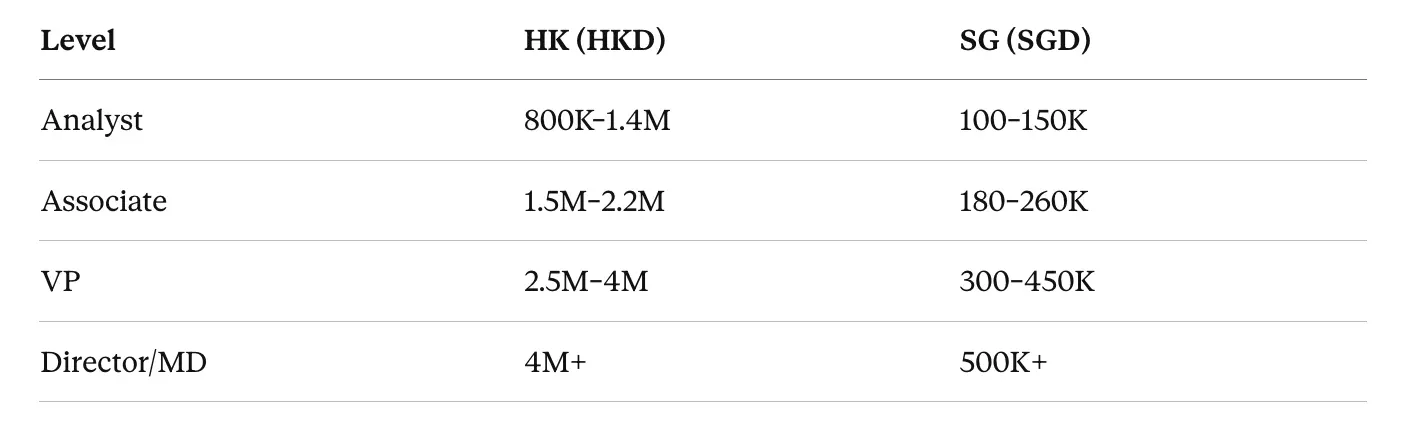
Figures are base salary. Total compensation including bonus is significantly higher — analyst bonuses at bulge bracket firms typically run 50–100% of base in good years, and VP and above bonuses can exceed base substantially.
Cost of living is high in both cities. Housing is the dominant expense. Both cities rank consistently among the world's most expensive property markets. Singapore is generally considered slightly more liveable and affordable day-to-day, while Hong Kong's housing costs are particularly acute.
For a more extensive HK salary breakdown, check out this report.
Career Trajectory & Exit Opportunities
Hong Kong
A Hong Kong IB stint opens doors to:
- Greater China private equity: The most direct exit, particularly for those with China coverage or M&A experience
- Corporate development roles at Chinese or multinational companies with Asia operations
- Hedge funds with Asia-Pacific mandates
- Relocation to mainland China for those with Mandarin and China deal experience
The China angle is a genuine differentiator. Bankers with 3–5 years of HK IB experience and China deal exposure are well-positioned for senior roles at Asia-focused funds that are harder to access from a Singapore base.
Singapore
A Singapore IB stint opens doors to:
- Southeast Asia PE and VC: The most natural exit, particularly for those with ASEAN coverage
- Sovereign wealth funds: GIC and Temasek are both headquartered in Singapore and are significant employers of former bankers
- Regional corporate finance roles at multinationals using Singapore as their Asia HQ
- Fintech and growth-stage companies across Southeast Asia
Singapore's PE ecosystem is growing rapidly, and the GIC/Temasek pipeline is a genuinely distinctive feature. Routes into sovereign wealth that simply don't exist to the same extent in Hong Kong.
Work Culture & Lifestyle
Both cities are demanding. Investment banking hours are long everywhere in Asia, and both HK and Singapore have reputations for intense work culture. That said, there are real differences.
Hong Kong
- Fast-paced, high-pressure deal culture
- Strong social scene with an active expat community
- Proximity to mainland China makes weekend trips to Shenzhen and Shanghai easy
- Outdoorsy — hiking, beaches, and islands are genuinely excellent
- Political environment has been more uncertain post-2019, which has affected some professionals' comfort with long-term commitment to the city
- Higher density, smaller living spaces at equivalent price points vs. Singapore
Singapore
- Often described as slightly more structured and process-oriented in work culture
- Cleaner, greener, and generally considered more "liveable" for families
- Excellent food, multicultural environment, and strong infrastructure
- Less volatile politically — Singapore's government stability is a significant draw for long-term planners
- Warmer year-round (consistently 30°C+), which is a plus or minus depending on preference
- Better connectivity to Southeast Asia for travel
Which Should You Target?
There's no universal right answer, but here's a practical framework:
Target Hong Kong if:
- You have Mandarin skills or are actively developing them
- You want direct exposure to China deal flow and Greater China PE exits
- You're earlier in your career and want maximum deal volume and prestige
- You're comfortable with a more volatile macro environment
Target Singapore if:
- English is your primary (or only) professional language
- You're interested in Southeast Asian markets, sovereign wealth, or fintech
- You're thinking about long-term settlement or have a family
- You want more geographic stability and a more diversified deal environment
Consider both if:
- You're open to relocating: Many bankers move between the two cities over the course of their careers, and experience in one is genuinely transferable to the other
- You're targeting global banks: Bulge brackets rotate analysts and associates between HK and SG offices, so applying broadly makes sense
Practical Next Steps
If you're actively targeting IB roles in either city:
- Build your technical foundation: financial modelling, valuation, and accounting fundamentals are prerequisites. Our Complete Finance & Valuation Course and Excel for Business & Finance course cover exactly what HK and SG banks test in interviews.
- Search targeted job boards: For Hong Kong specifically, ExpatJobBoard.com lists roles that don't require Cantonese or Mandarin, which makes it much easier to identify opportunities genuinely open to English-speaking candidates.
- Register with specialist recruiters: Michael Page, Robert Walters, Selby Jennings, and Heidrick & Struggles all have active HK and SG banking desks worth contacting early.
- Build your regional network: LinkedIn connections with bankers currently in HK or SG, alumni networks from your university, and informational interviews with people in target roles will all pay dividends.
Both Hong Kong and Singapore offer exceptional platforms for a career in investment banking. The right choice depends on your language skills, deal interests, and lifestyle preferences.
Other Articles You Might Find Helpful


Ready to Level Up Your Career?
Learn the practical skills used at Fortune 500 companies across the globe.